


If your child has an Individualized Education Program (IEP), it is natural to wonder whether the services and accommodations in the plan are actually happening, from speech therapy to extended time on tests. Knowing how to make sure your child’s IEP is followed is one of the most important steps you can take as a parent.
These concerns are common. Roughly 15 percent of U.S. public school students have an IEP, and in Massachusetts that number is closer to one in five. Yet having a strong IEP on paper and having it delivered in the classroom are two different challenges.
The most important thing to remember is simple: the IEP is a legal document, not a suggestion. Regularly check that your child is receiving what the IEP promises, and keep a written record of what you observe.
What Is an IEP?
An IEP is a legal plan for your child’s education. It explains what your child needs to learn, what support the school will provide, and what goals your child will work toward. A child may have an IEP when their learning, developmental, emotional, behavioral, physical, or health related needs significantly affect their education and they need specialized instruction or services. For example, this may include dyslexia, ADHD, or significant emotional or behavioral needs. IEPs are covered by a federal law called the Individuals with Disabilities Education Act or IDEA.
Parents often ask how an IEP is different from a 504 Plan. A 504 Plan is for students who have a physical or mental health condition that substantially limits one or more major life activities, including learning. A 504 Plan generally provides accommodations, such as extra time on tests, breaks, preferential seating, or access to assistive technology. An IEP can include accommodations too, but it also provides specialized instruction and/or related services when a student needs them to access and make progress in their education.
When your school district agrees to your child’s IEP, the supports and services written in the plan are legally required. They are not suggestions. As a parent, it is important to regularly check that what is happening at school matches what is written in the IEP and to keep your own notes.
What to Highlight in Your Child’s IEP
Every IEP has the same main parts: how your child is doing now, yearly goals, services, accommodations, where your child learns, and how progress will be measured.
As you read the IEP and evaluation reports, highlight your child’s areas of need. Then highlight the accommodations, services, and goals. Looking at them side by side helps you see whether each need is being addressed. For example, if the evaluation says your child has a hard time reading smoothly, but the IEP has no reading goal or reading help, that is something to ask about.

Five Strategies to Help Ensure the IEP Is Followed
You are not in the classroom every day, but you can still stay informed. These strategies help you keep track of how the IEP is working while building a good relationship with your child’s team.
1. Start a simple implementation tracker.
For every service in the IEP, whether speech, occupational therapy, counseling, or resource room time, track whether it is happening at the frequency and duration written. A missed session now and then may simply be logistics. A consistent pattern is worth documenting.
2. Check in with teachers and your child.
Periodic check-ins help you understand how things are going and strengthen your relationship with teachers. Ask your child, too. Younger children may not know the names of their services, but they can often tell you whether they saw a certain teacher that week.
3. Request service logs.
You have the right to ask service providers, such as your child’s speech therapist, to show you a record of the sessions your child has received. This is one of the easiest steps you can take. It also gives you a written record, which can help if a problem comes up later.
4. Ask specific questions.
General questions get general answers. Instead of asking how things are going, ask whether extended time is being offered on tests, or whether your child is seated where the IEP says.
5. Raise concerns early and in writing.
Do not wait for the annual meeting if something is not working. Start informally with an email to your child’s case manager that references the specific section of the IEP. For example: “The IEP lists speech services twice weekly for 30 minutes. My understanding is that my child has received one session in the past three weeks. Could you help me understand what is happening?” A friendly, factual email opens a conversation and creates a record at the same time.
It also helps to know that if the school proposes a change to the IEP and you disagree, your child generally has the right to remain under the current IEP while the disagreement is worked out. You should never feel pressured to agree to a change on the spot.
Preparing for IEP Meetings
IEPs must be reviewed at least once a year to make sure your child is making progress and receiving the right supports and services. At least every three years, your child must be reevaluated to determine whether they still qualify for special education and whether their needs or services have changed. You can also request an IEP meeting at any time. A little preparation can make these meetings far less overwhelming:
- Review documents ahead of time. Ask for the draft IEP and evaluation reports before the meeting.
- Bring a list of questions and concerns. It is easy to forget something once the conversation begins.
- Work with the team. Teachers and providers want your child to succeed. Most of them chose to work in education because they care about helping children and supporting families, so think of them as allies in your child’s success.
- Invite people who can help. You can bring another caregiver, a therapist, a coach, an advocate, or someone simply to support you or your child. Let the school know ahead of time.
- Take notes. Keeping a record of what was discussed and agreed upon can help you track your child’s progress and follow up on concerns.
And remember, it is completely normal to feel nervous. IEP meetings can feel overwhelming, with many people in the room and a lot of information to take in. Many parents worry about asking the wrong question or not understanding everything that is said. It is okay to ask the team to slow down, explain a word, or repeat something. Keep in mind that everyone at the table is there for the same reason: to see your child succeed.

Helping Your Child Advocate for Themselves
A child of any age can be invited to attend all or part of their IEP meeting. Federal law requires that students be invited by age 16, and in Massachusetts, by age 14. Yet research shows that only about a third of students attend their own IEP meetings, and most who attend are not actively participating. Self-advocacy is a skill to build, not assume.
Studies have shown that involving students in the IEP process is associated with greater self-determination, a better understanding of their own learning needs, and increased confidence in decision-making. Depending on their age and comfort level, children can:
- Share their strengths and challenges.
- Identify which supports help them, and why.
- Present part of the meeting, such as a goal or what they want teachers to know.
- Name something they would like to accomplish at school.
- Track their own progress and speak up when something is not working.
What to Do If the IEP Is Not Being Followed
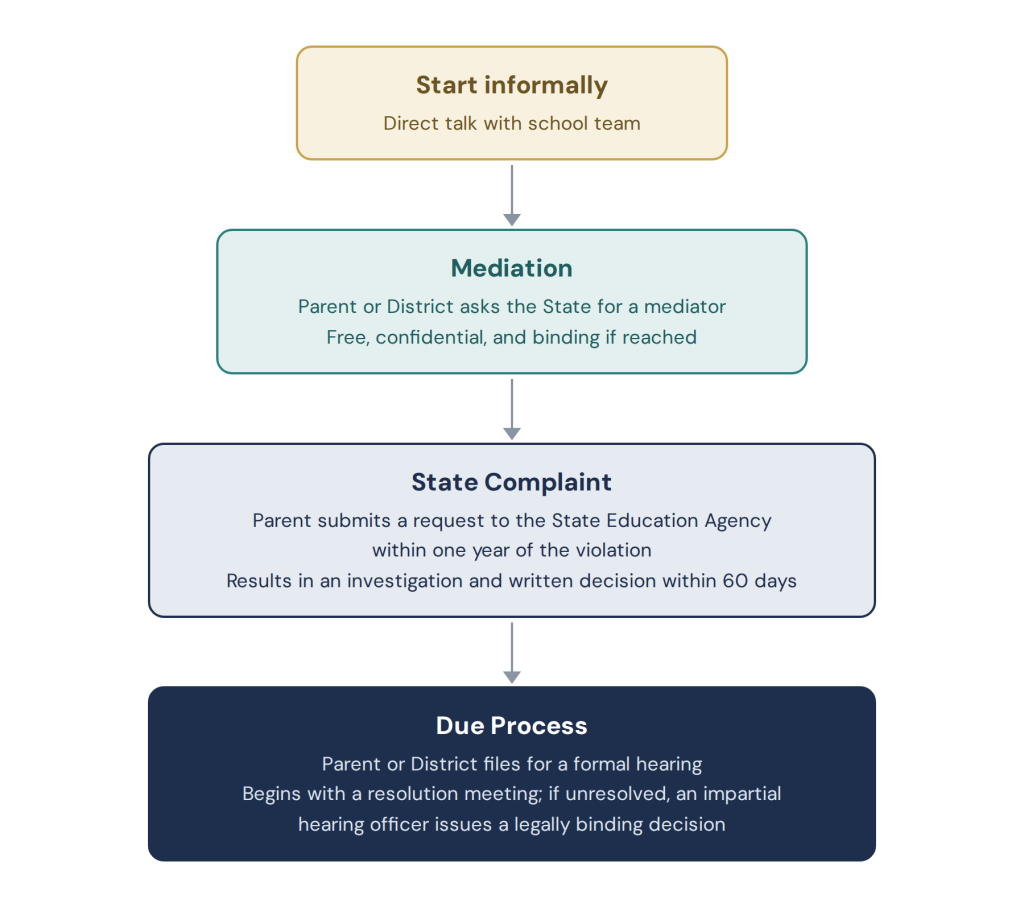
If the school is not doing what the IEP says, you have options. IDEA gives parents several ways to fix problems when a school falls short. These steps do not always happen in order, and you can ask for an IEP meeting at any time, not just at the yearly review. In most cases, the process looks like this:
- Talk informally with the school team. Email your child’s case manager about the problem, and point to the part of the IEP that is not being followed. Often, you and the school can agree to change the IEP to fix the problem.
- Mediation. If talking does not solve the problem, a neutral person can help you and the school reach an agreement. Mediation is free and voluntary.
- State complaint. You can file a written complaint with your state’s education department, which will look into the problem.
- Due process hearing. This is a formal legal hearing where a hearing officer listens to both sides and makes a decision.
Resources for Parents
You do not have to figure out the IEP process on your own. These trusted organizations offer free information, guidance, and support to help you speak up for your child.
- Parent Training and Information Centers – Every state has at least one, offering free IEP resources, one-on-one support, and workshops.
- Wrightslaw – Plain-language explanations of special education law, IEP rights, and advocacy strategies.
- COPAA – A national directory of special education attorneys and advocates, searchable by state.
- Understood.org – Parent-friendly explainers on IEPs, 504 Plans, ADHD, dyslexia, and autism.
- Special Education Parent Advisory Councils – Nearly every Massachusetts district has a SEPAC, which connects you with other parents and often leads to trusted advocate referrals.
Supporting Families at Bain Health and Wellness Center in Arlington, MA, and Throughout Massachusetts
Navigating the IEP process can feel stressful, especially when your child is also struggling at school. At Bain Health and Wellness Center, our experienced therapists work with many children and teens who have IEPs. Many of the children we see are also facing mental health concerns, such as anxiety, OCD, depression, and difficulty managing emotions, along with challenges related to ADHD and autism. We work closely with children, parents, and schools to build self-advocacy skills, strengthen communication, and use evidence-based strategies that fit each child’s unique needs. We offer both in-person and virtual therapy throughout Massachusetts. We’d love to discuss your needs and offer guidance on the next steps. Get in touch today!
References:
National Center for Education Statistics. “Students With Disabilities.” Condition of Education, U.S. Department of Education. https://nces.ed.gov/programs/coe/indicator/cgg/students-with-disabilities
Sanderson, K. A., & Goldman, S. E. “Understanding the Characteristics and Predictors of Student Involvement in IEP Meetings.” The Journal of Special Education, 2021.
U.S. Department of Education. “Individuals with Disabilities Education Act.” https://sites.ed.gov/idea/
U.S. Department of Education, Office for Civil Rights. “How to File a Discrimination Complaint.” https://www.ed.gov/about/offices/list/ocr/complaintintro.html