


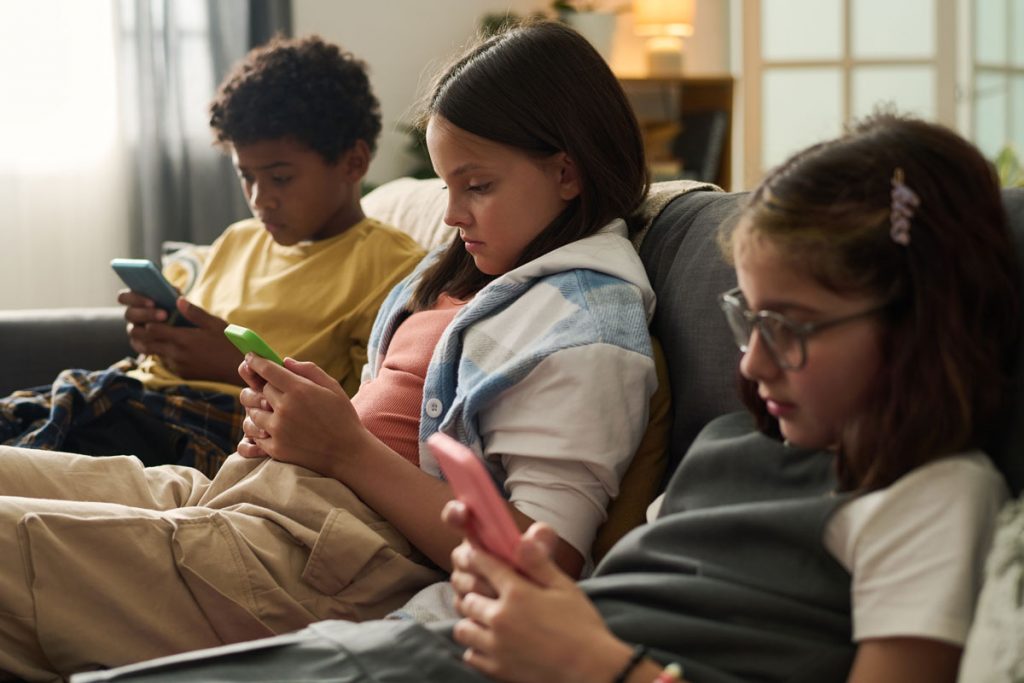
If you feel like you’re constantly wondering whether your child is spending too much time on a screen, you’re not alone. One of the most common questions parents ask is, “How much screen time is too much?” Unfortunately, there isn’t a simple answer. The effects often depend on how screens are being used, what children are viewing, and what activities screens are replacing.
Screens are now part of nearly every aspect of daily life. Children use technology to learn, communicate with friends, complete homework, play games, and simply relax. At the same time, many parents worry about the effects of excessive screen use on their child’s sleep, behavior, attention, and emotional well-being.
The good news is that the conversation around screens has shifted. For years, the advice was simple and rigid: two hours a day, no more. That number felt clean, but it never captured the real picture. For example, a child who spends an hour video chatting with grandparents or completing an educational activity is having a very different experience than a child spending five hours scrolling social media alone late into the night. In January 2026, the American Academy of Pediatrics (AAP) moved away from strict hour counts and toward a more useful question: is this screen time helping your child or getting in the way of something they need more?
It Is Not About All or Nothing
Taking screens away completely may seem like the safest choice, but for older children and teens, learning to use technology responsibly is an important life skill. Rather than eliminating screens, the goal is to help children build a healthy, balanced relationship with them. At the same time, too much screen time carries real risks. Research links excessive use to disrupted sleep, reduced physical activity, difficulty with attention and self-regulation, and less face-to-face interaction during years when those social skills are still developing.
For some children, especially those who already struggle with focus or emotional regulation, screens can become a way to avoid the harder, more effortful parts of daily life, like homework, chores, or working through frustration. None of this means screens are the enemy. It means screens deserve the same intentionality you already bring to other parts of parenting.
What the Research Recommends at Each Age
The updated AAP guidance breaks down expectations by developmental stage, and the differences matter.
Under 18 months. Screens are discouraged entirely, with one exception: video chatting with a parent or relative who is away. During infancy, children learn best through face-to-face interaction, talking, singing, reading, and exploring their environment.
18 to 24 months. If screens are introduced, they should be limited to high quality educational programming watched together with a caregiver. Co-viewing matters here. A toddler watching alone absorbs far less than a toddler watching with a parent who points things out and connects what is on screen to real life.
Ages 2 to 5. Approximately one hour per day of high-quality, age-appropriate content is the general benchmark. This is still a season where less is better, and where the content itself, not just the clock, determines how valuable that time is.
Ages 6 and up. This is where the guidance shifts most. For many children, keeping recreational screen time to around one to two hours per day is a reasonable goal, although individual needs vary. Rather than a fixed number of hours, though, the AAP now recommends a framework built around five questions, sometimes called the 5 Cs:
- Who is the child, and how do they respond to screens.
- What is the content, and is it age appropriate.
- What is the context, meaning is your child watching alone or with the family.
- Can your child stay calm and fall asleep without a screen.
- And is screen time crowding out something important, like sleep, movement, homework, or in person friendships.
Teens. Adolescents require increasing independence, but they still benefit from clear expectations. Instead of counting every minute, parents should monitor how technology affects sleep, school performance, friendships, mood, and overall functioning. Helping teens develop self-control is often more effective than constant monitoring.

Five Practical Strategies Backed by Research
Parents often tell us that setting limits leads to arguments, tears, or constant negotiations. The good news is that a few approaches consistently show up as effective across the research, and they tend to work because they are collaborative rather than purely restrictive.
1. Create Clear Family Rules.
Sit down with your child and discuss what screens are for, when they are used, and where. A few examples of clear, consistent expectations to start with:
- No screens during meals.
- Screens stay out of bedrooms overnight.
- Homework and responsibilities come first.
Children do best with clear, consistent routines rather than rules that shift day to day, and kids are more likely to follow limits they helped shape and can predict.
2. Protect specific times and spaces.
Keep screens out of bedrooms and off the table during meals. Turn devices off 30 to 60 minutes before bedtime, since blue light and stimulating content both interfere with falling asleep. A simple example: instead of a phone charging on the nightstand, set up a charging station in the kitchen or hallway where every device, including yours, plugs in overnight.
3. Give advance warnings.
Transitions away from enjoyable activities are hard for many children, especially neurodivergent children with ADHD and autism. Instead of abruptly turning off the tablet, give a few reminders as the end approaches, such as “ten minutes left,” then “five more minutes,” then “one more minute.” Timers and countdowns can also help make the transition predictable rather than abrupt.
4. Avoid using screens as the default off switch for hard emotions.
It is tempting to hand over a tablet during a meltdown or a long car ride, and occasionally that is fine. The concern is when screens become the only tool a child has for managing boredom, frustration, or big emotions, which can get in the way of developing other coping skills. Keeping a small backup kit in the car, such as a coloring book, a fidget toy, or an audiobook, gives your child another option besides a screen when things get hard.
5. Model the behavior you want to see.
Children notice when parents are on their own phones. If parents are constantly checking emails during dinner or scrolling through their phones while talking to their children, it becomes harder to expect different behavior from them. Consider creating family “screen-free” times where everyone puts devices away.

Tools That Can Help
Common Sense Media is one of the most widely trusted resources for reviewing the actual content of shows, apps, and games before your child dives in, which lines up directly with the AAP’s emphasis on content quality over raw hours.
Several evidence-based tools allow you to set schedules, review usage, and adjust limits without needing a separate subscription. Widely recommended tools include:
- Google Family Link – Allows parents to set screen time limits, approve downloads, monitor app use, and locate devices.
- Apple Screen Time – Built into Apple devices, allowing parents to create downtime schedules, app limits, and content restrictions.
- Microsoft Family Safety – Provides screen time management across Windows and Xbox devices.
- Bark – Monitors texts, email, and social media for concerns such as cyberbullying, suicidal language, or inappropriate content while promoting privacy through alerts rather than constant monitoring.
When Screen Use Becomes a Concern
Most families drift in and out of balance, and one heavy screen day is not a red flag. What matters is a pattern. Watch for intense meltdowns when a device is taken away, screens regularly disrupting sleep, fading interest in friends or hobbies, grades slipping due to distraction, or screens winning out over food, rest, or hygiene. If several of these last more than a few weeks, it may be time to limit screen time or bring in outside support.
Start with your child’s pediatrician, who can rule out other factors and guide next steps. If the concern seems tied to attention, mood, anxiety, or emotional regulation, a mental health provider can help identify what is driving the screen use, since it is often a symptom rather than the root problem. Therapy focused on coping skills, underlying anxiety or attention difficulties, and family communication can make a real difference for the whole household.
Parents don’t have to navigate these challenges alone. Early support can prevent patterns from becoming more difficult to change.
Supporting Families at Bain Health and Wellness Center in Arlington, MA, and Throughout Massachusetts
If screen use has become a source of stress in your family, you’re not alone. At Bain Health and Wellness Center, our experienced therapists work with children, adolescents, young adults, and parents to address concerns related to emotional regulation, ADHD, autism, anxiety, depression, and more. We help families create realistic routines, strengthen communication, and develop evidence-based strategies that fit each child’s unique needs. We offer both in-person and virtual therapy throughout Massachusetts, providing individualized support to help children thrive both on and off the screen.
References:
American Academy of Pediatrics. “Beyond Screen Time: Policy Discusses How to Approach Immersive Digital Ecosystem.” AAP News, January 20, 2026. https://publications.aap.org/aapnews/news/34088/Beyond-screen-time-Policy-discusses-how-to
American Academy of Pediatrics. “Understanding the New AAP Digital Media Guidelines for Screen Time and Social Media.” AAP.org. https://www.aap.org/en/patient-care/media-and-children/center-of-excellence-on-social-media-and-youth-mental-health/understanding-the-new-AAP-digital-media-guidelines/
American Academy of Child and Adolescent Psychiatry. “Screen Time and Children.” AACAP.org. https://www.aacap.org/AACAP/Families_and_Youth/Facts_for_Families/FFF-Guide/Children-And-Watching-TV-054.aspx
Wang, Y., et al. “Excessive Screen Time Is Associated with Mental Health Problems and ADHD in US Children and Adolescents: Physical Activity and Sleep as Parallel Mediators.” National Survey of Children’s Health, 2020–2021. https://arxiv.org/pdf/2508.10062