


When Your Child Needs the Routine and Resists It
If you parent a child with both autism and ADHD, sometimes called AuDHD, you have probably noticed something that does not show up in most parenting books. Your child seems to need routines and resist them at the same time. They melt down when the schedule changes, then push back when you try to follow the schedule. Bedtime is too rigid one night and not predictable enough the next. You build a beautiful morning chart, and by Tuesday it is wrinkled, ignored, or torn off the fridge.
This is not a discipline problem. It is not a sign that you have failed at consistency. It is the very real result of two different neurotypes pulling in opposite directions inside the same child.
Autistic traits often include a deep preference for sameness, predictability, and ritual. Routines can feel safe and regulating. ADHD traits often pull the other way, toward novelty, stimulation, and movement. The same child can crave the comfort of a familiar bedtime story and feel restless and bored two minutes into it. The American Psychiatric Association describes this tension directly, noting that people with autism often focus on routines and sameness while people with ADHD may be easily distracted and look for new and different experiences (Psychiatry.org, 2023).
For a child with both, that tension shows up dozens of times a day.
What the Research Says About Routines and the AuDHD Brain
Routines are also hard for a real, measurable reason. Both autism and ADHD affect executive functioning, the brain skills we use to plan, start, and shift between tasks. Research links these differences to the emotional and behavioral challenges parents see at home and suggests they can be even bigger when both conditions show up together (Scientific Reports, 2025).
So, when your child cannot seem to follow a routine, you have practiced fifty times, it is not because they are not listening. The brain machinery that turns “this is what we do at 7:30″ into actual action is doing more work than most people can see. Therefore, what looks like defiance, forgetfulness, or “not trying” is often a child whose brain is working overtime just to keep up with what we are asking.
Parents Carry a Real Mental and Emotional load

Parents in this situation carry a real mental and emotional load. Research consistently finds that parents of children with autism, ADHD, or both report significantly higher levels of parenting stress than parents of neurotypical children (Journal of Autism and Developmental Disorders, 2024). When children are autistic and also have ADHD, mothers tend to reach peak stress earlier than mothers of children with just one diagnosis. That peak often comes during the years when families are first building daily routines (May & Williams, 2022).
If you feel exhausted from holding the whole household’s schedule in your head, having the same conversation about teeth-brushing for the third week in a row, or watching the morning fall apart for reasons you cannot pinpoint, the research backs you up. This is genuinely harder than the parenting books make it sound.
Naming that matters. You are not too sensitive, too disorganized, or doing it wrong. You are doing one of the more demanding jobs in parenting. And if it feels like most of the parents around you have it figured out, the research says otherwise. Most families raising a child with autism, ADHD, or both are quietly wrestling with the same things you are. You are far from alone in this. The good news is that there are real, practical strategies that can make daily life feel a little less heavy, and a lot more doable.
5 Research-Supported Strategies for Building Routines That Actually Work
The goal is not a perfect routine. The goal is a flexible, supportive structure your child can lean on, especially on hard days.
1. Anchor the day with predictable touchpoints
A common mistake is building a routine that is too detailed. Rigid schedules collapse easily and tend to frustrate the ADHD side of your child’s brain. Instead, identify three or four daily anchors that stay the same every day. Wake-up, breakfast, after-school landing time, and bedtime are good starting points.
What happens between the anchors can shift. The anchors themselves stay steady. This gives the autistic side of your child the predictability it needs while leaving room for the ADHD side to breathe.
How to start: pick three anchors. Keep them in roughly the same order and the same place each day. Let everything else flex.
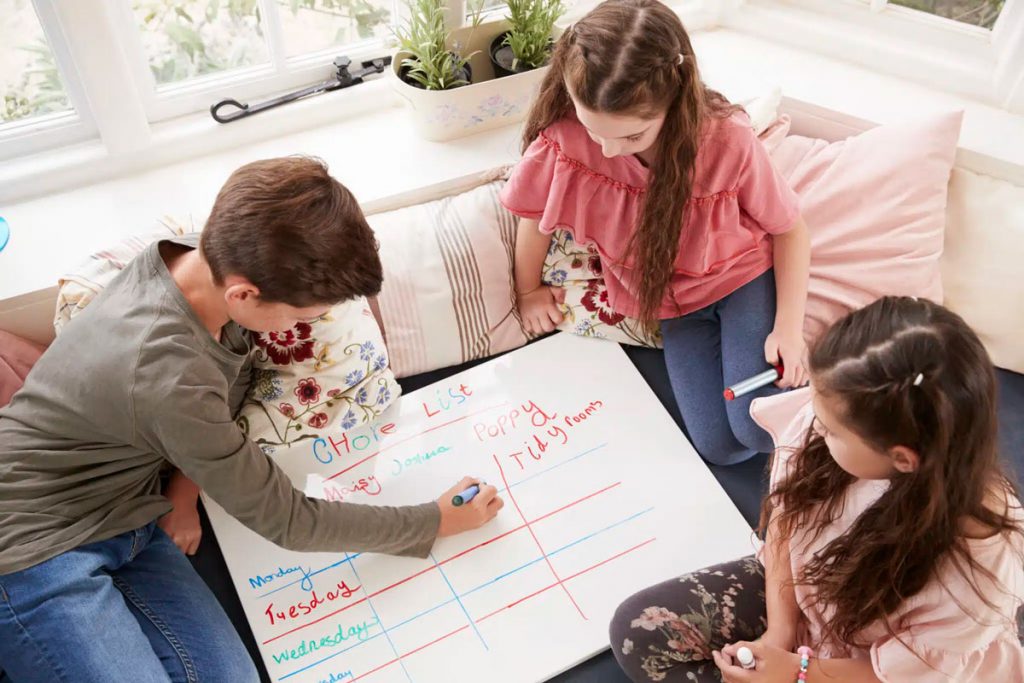
2. Make routines visible, not just verbal
Verbal directions ask your child’s working memory to do a lot. Visual supports do that work on the outside, where it does not get lost. Visual schedules are classified as an evidence-based practice for autistic children that help reduce problem behaviors and improve follow-through in children with ADHD (PMC, 2022).
How to start: try a simple visual checklist for one part of the day that consistently goes sideways. Pictures for younger children, written checklists for older ones. Keep it at child-eye level. Let your child cross items off or move pieces. The act of checking off matters as much as the list itself.
3. Build predictable novelty into the day
This sounds contradictory, and it is not. Your child’s ADHD side needs new input. If you do not plan for novelty, it will appear at inconvenient times, like the middle of a homework session.
Schedule it. A ten-minute movement break, a new song on the way to school, discover a new playground, a different snack choice on Wednesdays, a “weird question of the day” at dinner. Small novelty inside a steady frame satisfies the part of your child that needs stimulation without breaking the structure that calms them.
How to start: pick one daily routine that drags. Add one small, predictable bit of newness inside it.
4. Plan the transitions, not just the activities
For AuDHD kids, the hardest part of the day is often not the activity itself. It is the moment between activities. Transitions require stopping something interesting, organizing what comes next, and shifting attention, all of which draw heavily on executive function.
Front-load your transitions. Give a five-minute warning, then a two-minute warning, then a one-minute warning. Use a visual timer your child can see. Build in a transition object or ritual, like the same song between bath and bed, or a specific stuffed animal that travels with them from one space to another.
How to start: identify the one transition each day that causes the most trouble. Wrap it in warnings and a small ritual for a full week before evaluating.
5. Have a recovery plan for when the routine falls apart
Routines will fall apart. The illness, the snow day, the unexpected visit, the bad night of sleep. For a child whose nervous system relies on predictability, these moments are hard. For a child who also has ADHD, dysregulation can escalate quickly.
The most useful thing you can do in advance is plan for the breakdown. Decide what your bare-minimum routine looks like on a hard day. Three anchors instead of six. A simpler menu, a shorter bedtime, permission to skip the parts that are not essential. Tell your child the recovery plan exists before you need it. Knowing there is a backup version reduces panic for both of you.
It also helps to give any new plan time to settle. If your child does not get it on the first try, that does not mean the system is broken. One or two rough days are not enough information. You will only know whether a routine truly is not working if your child struggles with it consistently over several days. Give the plan room to become familiar before you decide to scrap it.
How to start: write down your hard-day version of bedtime. Practice it once when things are calm, so it feels familiar when you need it.
When to Reach Out for Professional Support

Some of this is normal family life, and some of it is a signal that more support could help. Consider connecting with a mental health professional if you notice any of the following:
- Daily routines consistently end in meltdowns, shutdowns, or aggression, despite your best efforts for a few weeks
- Your child is experiencing rising anxiety, especially around transitions, school, or sleep
- You notice signs of low mood, school refusal, or withdrawal from activities your child once enjoyed
- As a parent, you feel chronically depleted, isolated, or unable to imagine your days being better
None of this mean something is wrong with your child or your parenting. They mean the support load is bigger than one or two people can carry alone, and that is a reasonable point to bring in someone who can help.
Therapy Services Offered at The Bain Health and Wellness Center in Arlington, MA, and Throughout Massachusetts
If you believe your child could benefit from mental health support, finding an experienced clinician matters. At Bain Health and Wellness Center (BainHWC), we offer in-person and virtual counseling for children, teens, and young adults with autism, ADHD, anxiety, depression, trauma, OCD, and more. All clinicians at BainHWC are trained in evidence-based approaches and have several years of experience working with neurodivergent children and their families.
References
American Psychiatric Association. (2023). When Autism and ADHD Occur Together. https://www.psychiatry.org/news-room/apa-blogs/when-autism-and-adhd-occur-together
Journal of Autism and Developmental Disorders. (2024). Parenting Stress in Autistic and ADHD Children: Implications of Social Support and Child Characteristics. https://www.ncbi.nlm.nih.gov/pmc/articles/PMC12167323/
Neuroscience and Biobehavioral Reviews. (2024). A systematic review on the association between executive function and emotional regulation in autism, ADHD, and autism/ADHD. https://www.sciencedirect.com/science/article/pii/S0149763426000254
Scientific Reports. (2025). Simple Executive Function as an endophenotype of autism-ADHD. https://www.nature.com/articles/s41598-025-87863-2
The Efficacy of Visual Activity Schedule Intervention in Reducing Problem Behaviors in Children With ADHD: A Systematic Review. (2022). https://pmc.ncbi.nlm.nih.gov/articles/PMC8733412/